
Last updated November 14, 2026
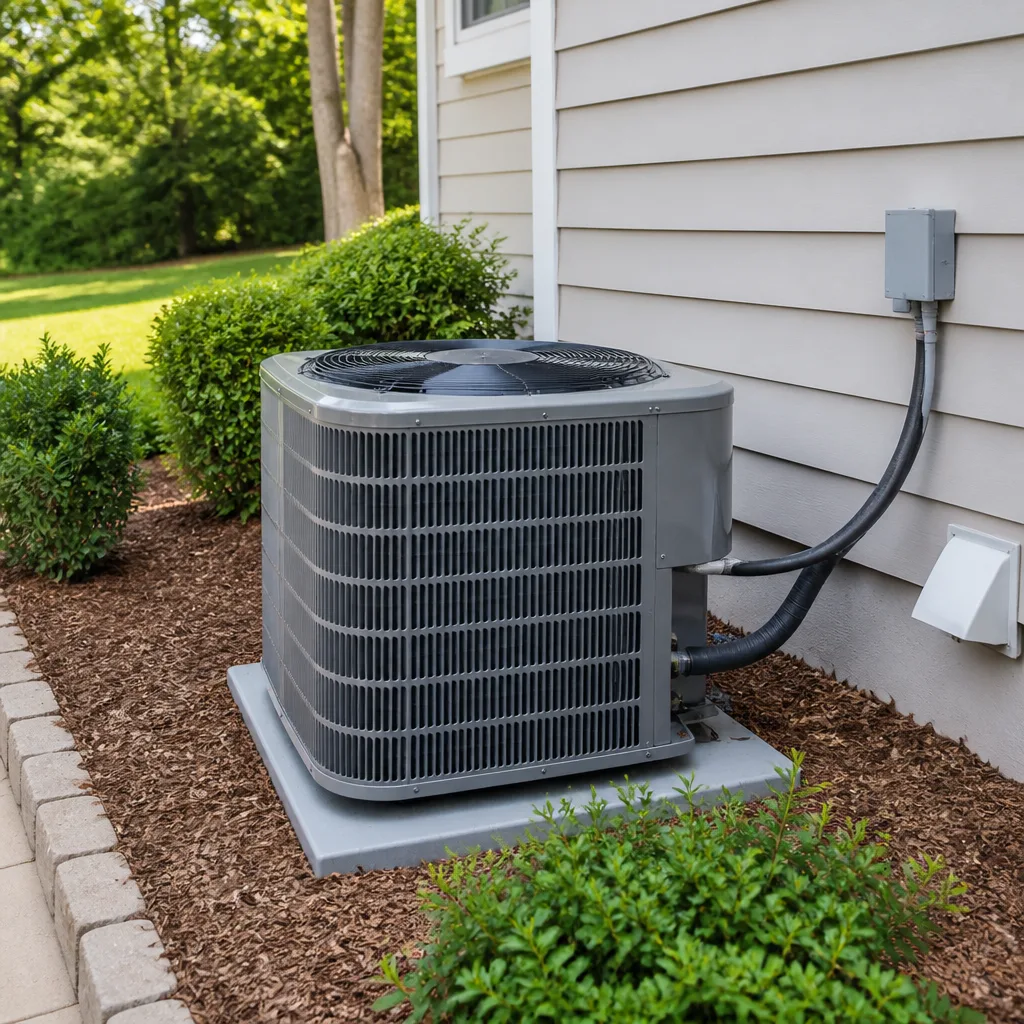 AC repair
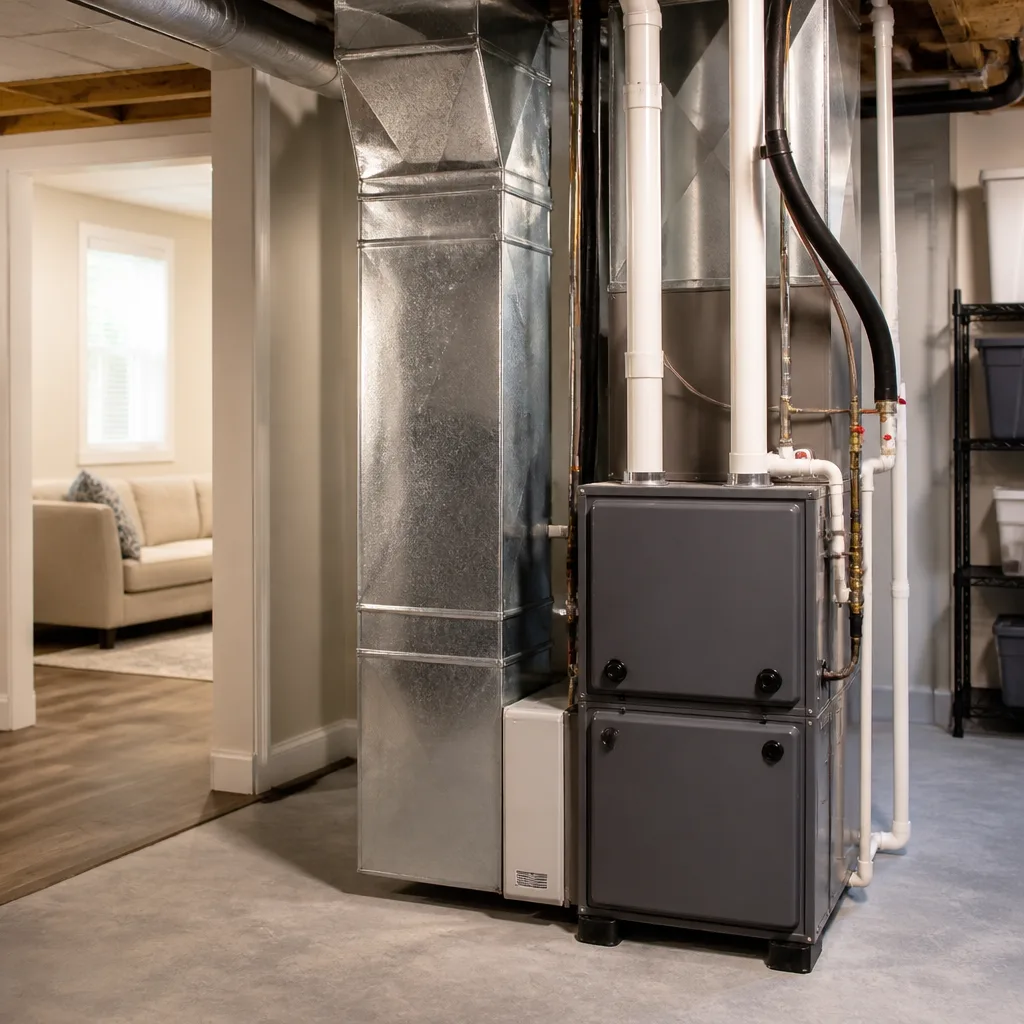 Furnace & heating
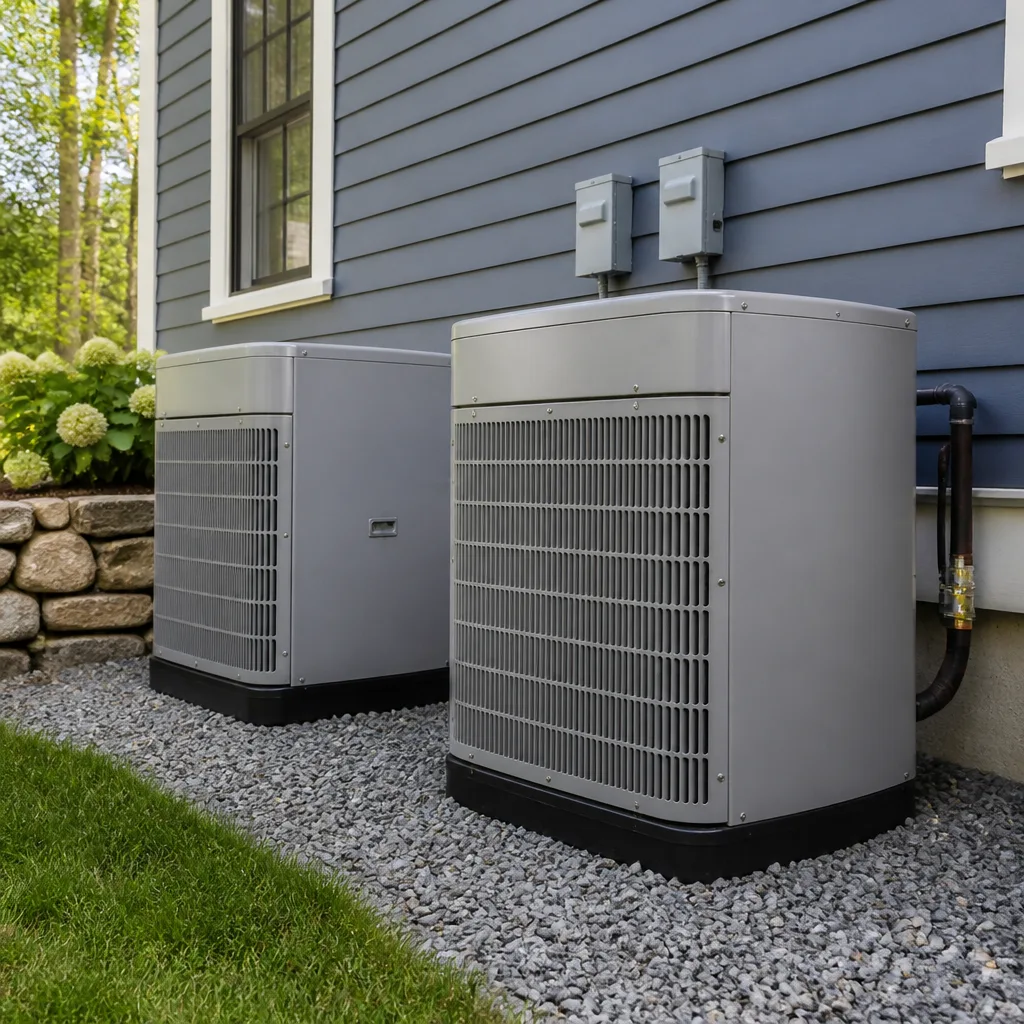 Heat pumps
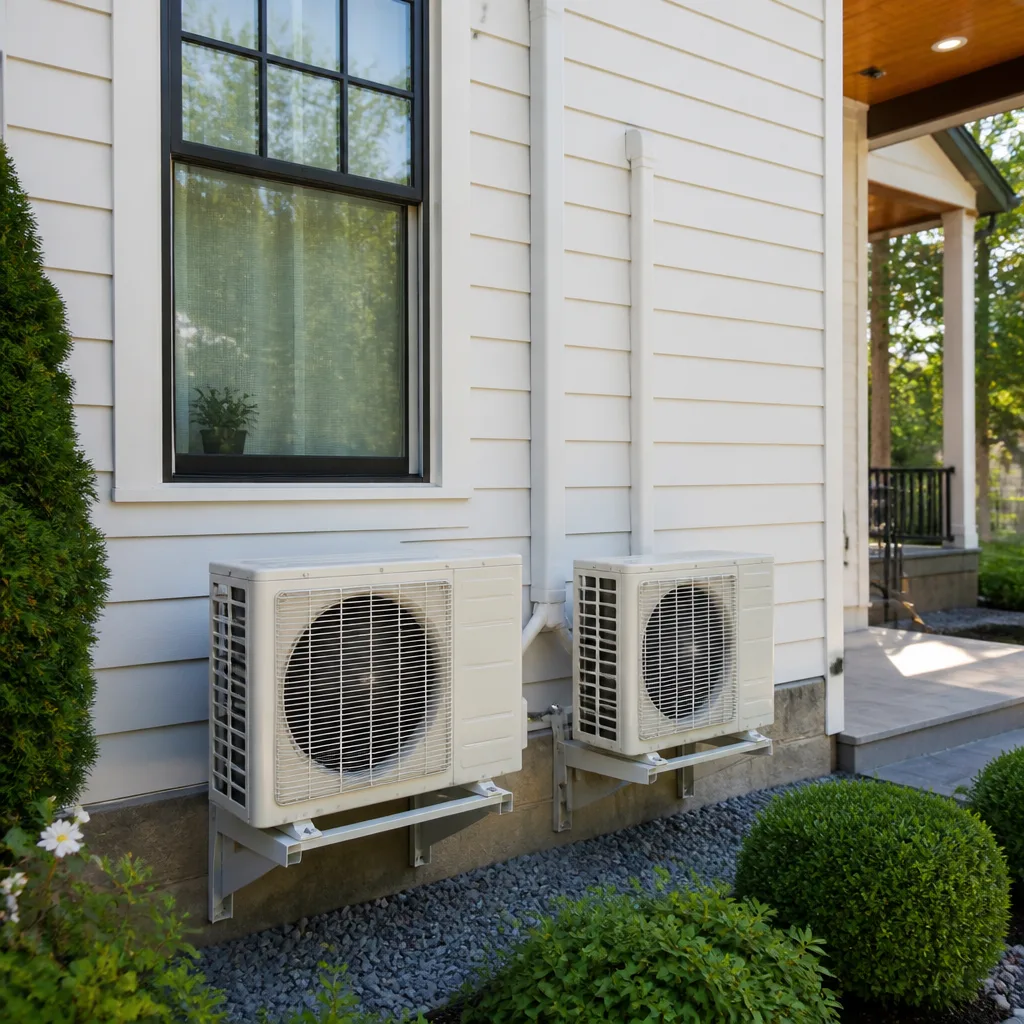 Ductless mini splits
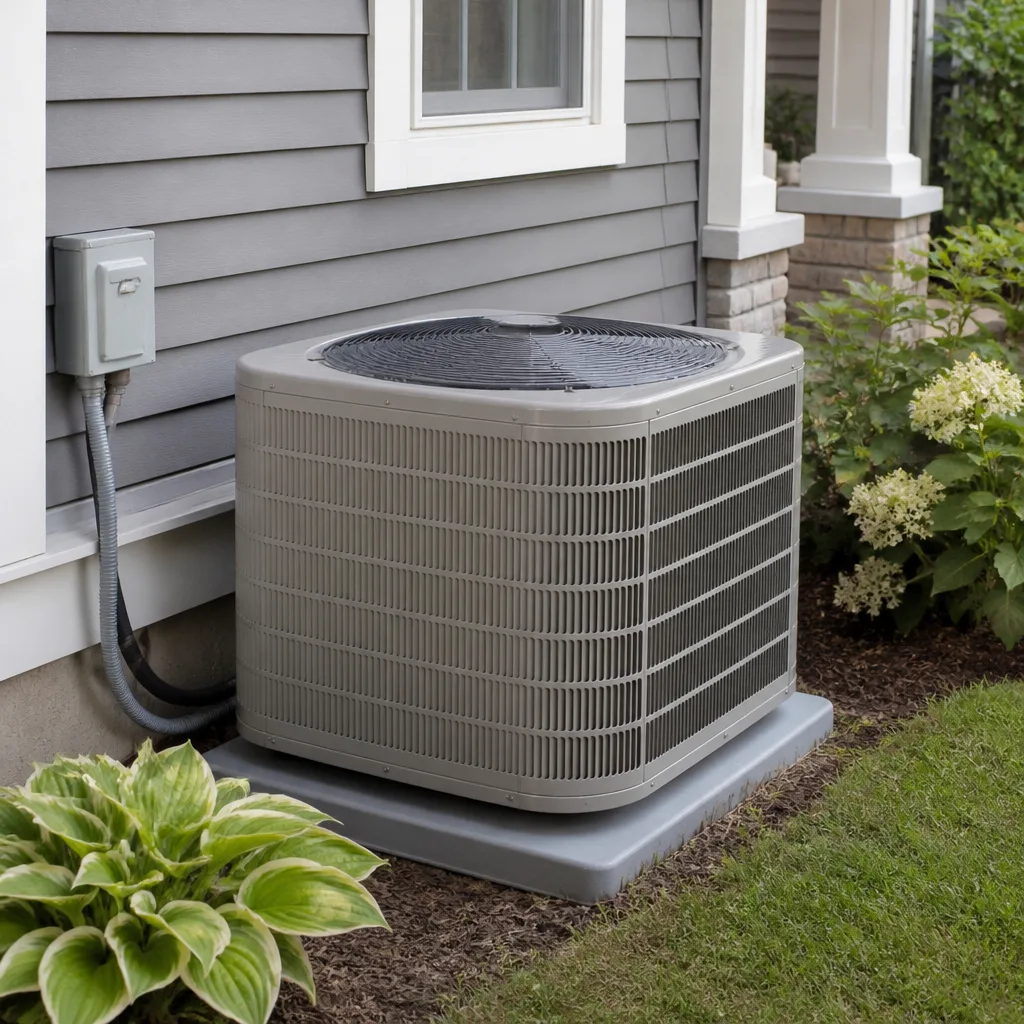 Carrier
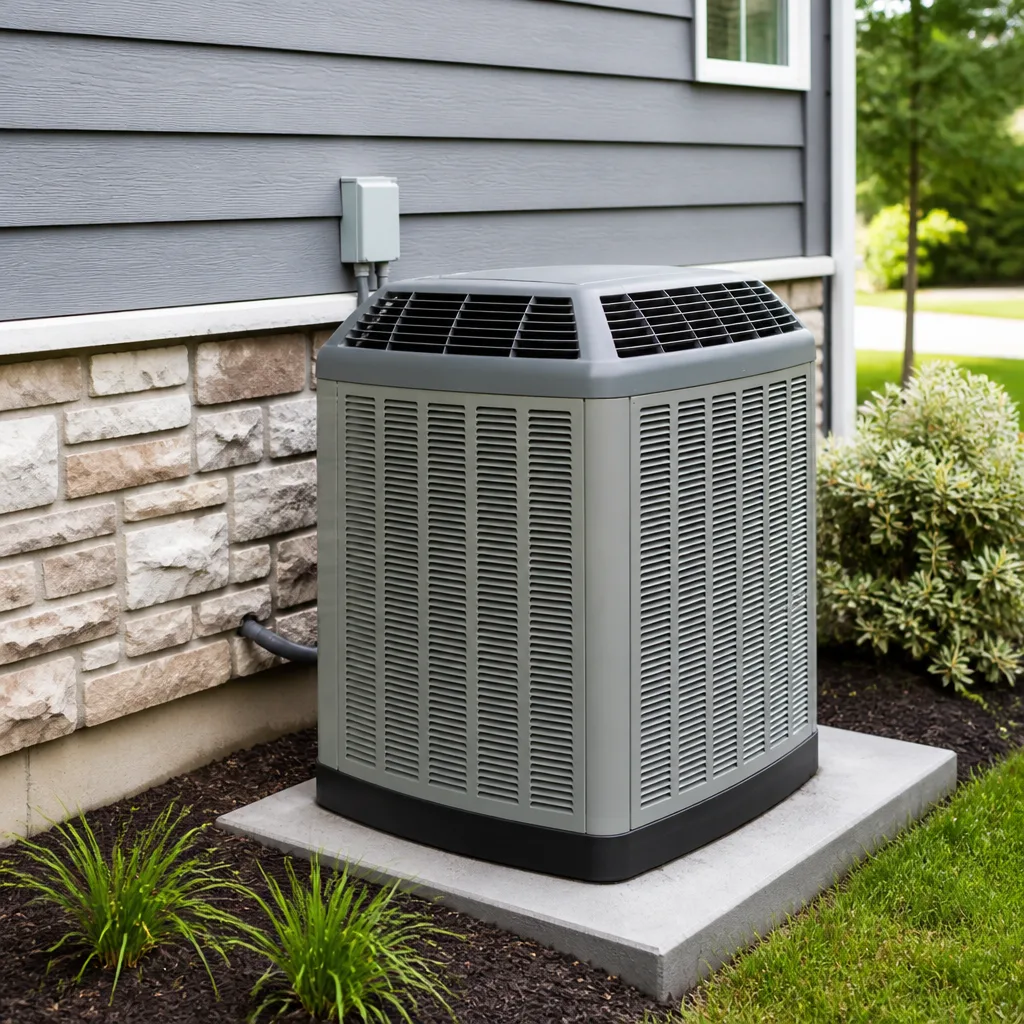 Trane
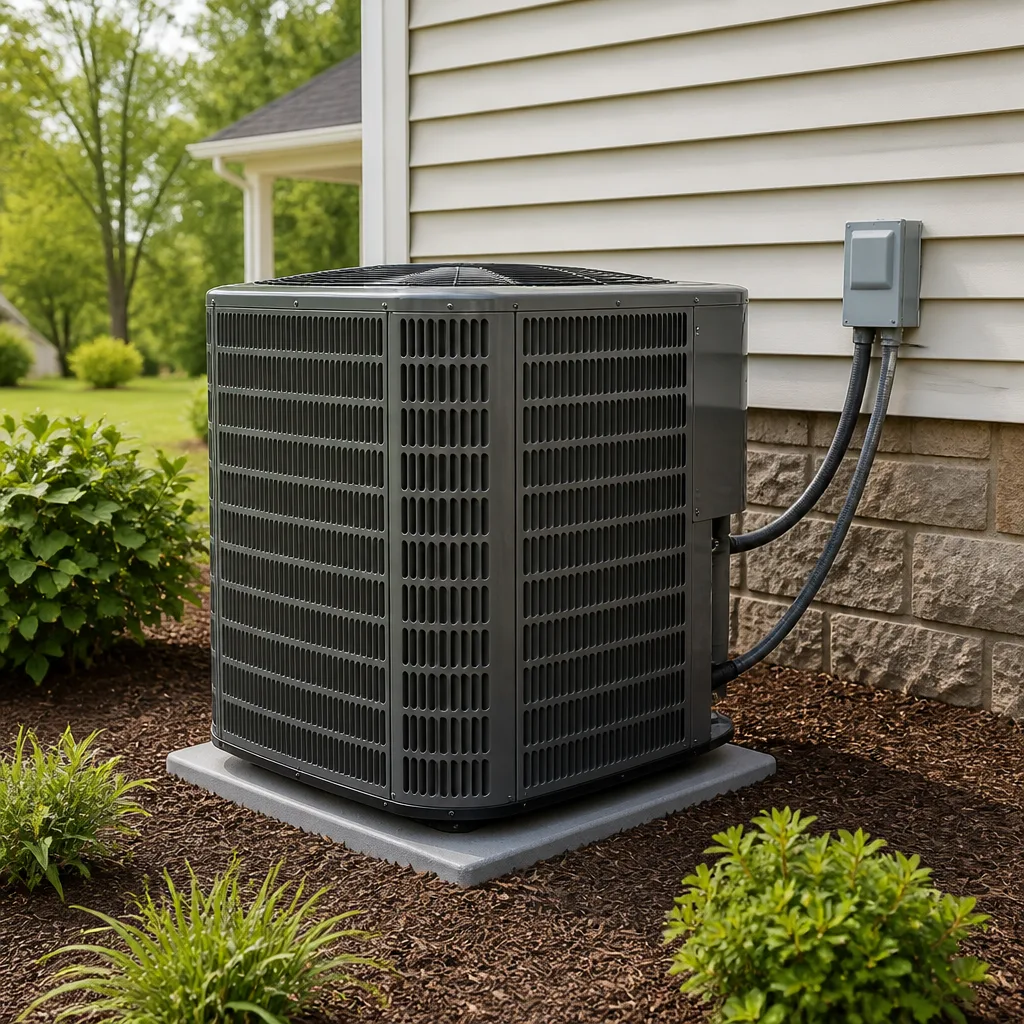 Goodman
Seasonal tune-up and full diagnostic on your Carrier, Trane, or Goodman system - readings shown to you before any repair is proposed
Diagnosis first, numbers second - you approve the repair price before a single part goes in.
Get your free estimateAC Repair Troubleshooting in North Las Vegas: Common Problems and How to Fix Them
A technician who shows up without you having done any observation is working blind, and you’re paying for that blind time. Most homeowners in North Las Vegas can narrow down what’s wrong with their AC in under ten minutes using nothing more than their eyes, ears, and a basic understanding of how a desert cooling system behaves under stress. This guide teaches you to read your own system so you can describe the problem precisely, push back on vague estimates, and avoid paying for unnecessary part replacements. By the time you finish reading, you’ll know what warm air but a running unit means, what short-cycling indicates, and what to leave alone for your own safety.
Quick Answer
Most AC failures in North Las Vegas come down to five issues you can identify yourself: a dirty condenser coil, a clogged drain line, a tripped breaker, a failing capacitor, or a thermostat that’s sending the wrong signal. Checking these takes about ten minutes and tells you whether you’re looking at a simple fix or a repair call. If the unit won’t start at all, check the breaker first. If it runs but blows warm air, look at the outdoor condenser coil and the filter. If it short-cycles, you’re likely dealing with overheating or a capacitor on its way out.
Styles & brands we work with
- AC repair
- Furnace & heating
- Heat pumps
- Ductless mini splits
- Carrier
- Trane
- Goodman
Table of Contents
- Why North Las Vegas Puts a Unique Load on Your AC
- Warm Air but the Unit Is Running
- Short-Cycling: What It Means and What to Check
- Unit Won’t Start at All: The Breaker and Beyond
- Dirty Coils and Clogged Drain Lines: The Dust Factor
- What Your Thermostat Is Telling You Before Anyone Opens the Unit
- How to Describe Your Problem So the Phone Diagnosis Is Accurate
- Common Mistakes to Avoid
- When to Call a Professional
- Frequently Asked Questions
Why North Las Vegas Puts a Unique Load on Your AC
A residential air conditioner in North Las Vegas works harder than the same unit in most other American cities. Summer highs routinely push past 105°F, and the system runs for hours at a stretch just to hold an indoor temperature in the mid-70s. That sustained runtime changes how failures show up. A capacitor that would limp along in a milder climate gives out faster here. A slightly dirty condenser coil that’s still efficient in Phoenix’s sister cities becomes a real problem when the outdoor unit sits in direct sun on a 110°F afternoon.
The dust is the second factor. The valley’s air carries fine alkaline dust that settles on condenser fins and works its way into the evaporator coil inside the air handler. Over a full cooling season, that layer of dust acts like a blanket across the coil, reducing the system’s ability to shed heat. The compressor then runs longer to reach the same setpoint, which raises your power bill and shortens the life of the equipment.
Third, the temperature swing between day and night matters. A system that starts in 70°F morning air and runs into 100°F afternoon air is operating across a wider thermal range than one in a more stable climate. That swing stresses wiring connections, capacitor dielectric, and compressor valves. None of this means your AC is doomed, but it does mean that AC repair calls in North Las Vegas tend to follow patterns we can predict and prepare for.
Warm Air but the Unit Is Running
The most common call we field in North Las Vegas goes something like this: “The unit is running outside, the fan is spinning, but the air coming out of the vents feels warm.” That specific symptom narrows the problem down quickly. The compressor may not be engaging, or the refrigerant charge may be low, or the condenser coil may be so clogged that it can’t reject heat into the outdoor air. Here’s how to tell them apart without opening any panels.
First, walk out and look at the outdoor unit. The fan on top of the condenser should be spinning. If it’s not, and the unit is humming, you may be looking at a failed fan motor or capacitor. If the fan is spinning but the air it’s pushing out of the top of the unit feels roughly the same temperature as the surrounding air, rather than noticeably warmer, the compressor may not be running or the refrigerant charge is low.
Second, check the air filter at the return grille inside the house. A filter that’s caked with gray valley dust restricts airflow across the indoor evaporator coil. When airflow drops, the coil gets colder than it should, and in extreme cases freezes into a block of ice. The system then blows air across that ice and delivers lukewarm air to the house. If you see ice anywhere on the indoor coil or the copper line set running to the outdoor unit, turn the system off at the thermostat and let it thaw before you call anyone. Running a frozen system can damage the compressor.
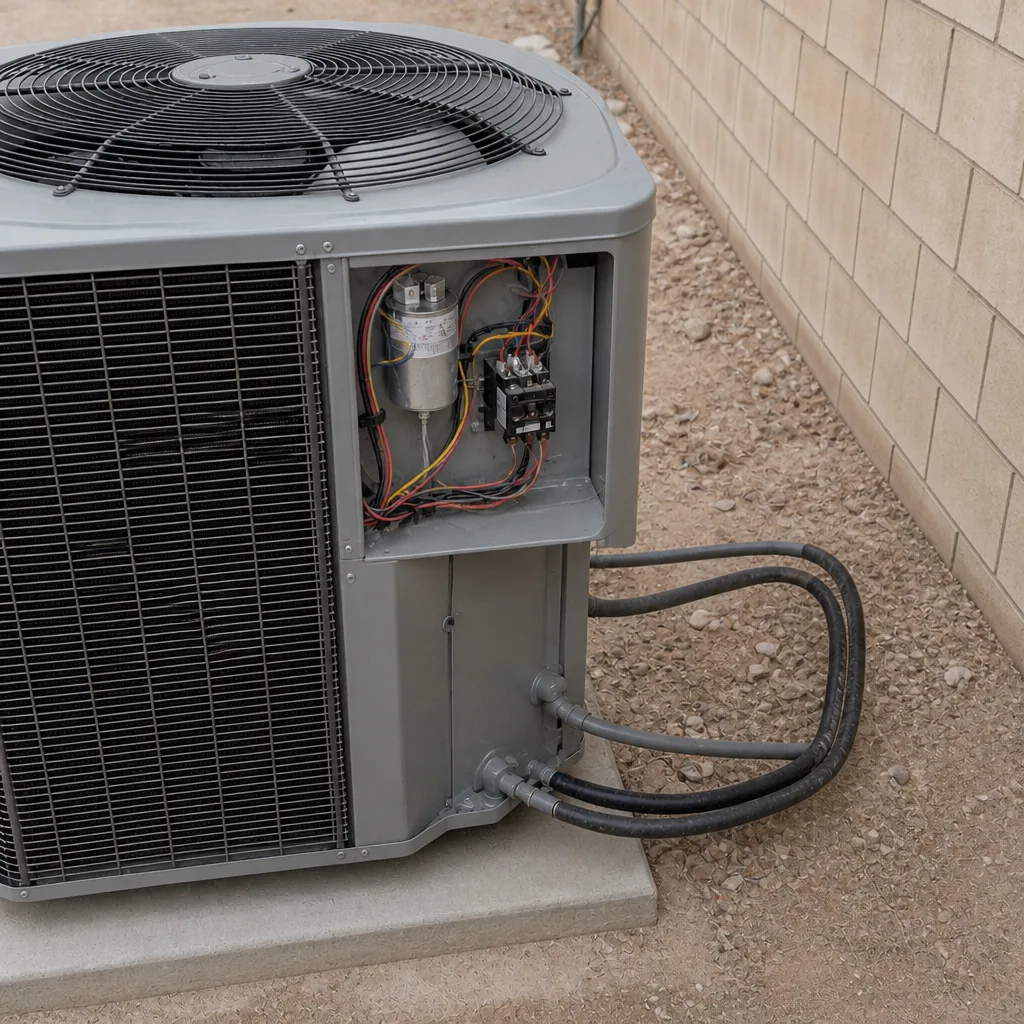
Third, look at the copper lines where they enter the outdoor unit. The larger insulated line should feel cold to the touch and may be sweating. The smaller uninsulated line should feel warm. If the larger line feels room temperature while the system runs, that’s a strong sign of low refrigerant or a compressor that isn’t pumping. That is not a do-it-yourself fix. Refrigerant handling requires EPA certification and specialized gauges.
Short-Cycling: What It Means and What to Check
Short-cycling is when the system turns on, runs for only a few minutes, shuts off, and then starts again a short time later. You’ll hear the compressor kick on and off repeatedly. In North Las Vegas’s summer, short-cycling is often worse in the late afternoon, when the outdoor unit is hottest and the system is under the most load. The causes break down into a few predictable categories.
- Overheating compressor. The compressor has an internal thermal overload that trips when the unit gets too hot. A dirty condenser coil reduces the system’s ability to shed heat, and the compressor internal temperature climbs until the overload opens. The system shuts off, cools down, and restarts. This is a protective cycle, not a failure, but it means the coil needs attention before the compressor sustains real damage.
- Failing capacitor. The capacitor stores the voltage needed to start the compressor and the condenser fan motor. As it weakens, it can still start the system sometimes but not reliably. That creates a pattern of starts, brief runs, and shutoffs that looks a lot like overheating. Capacitors are one of the most common parts replaced in this climate because heat accelerates their degradation.
- Airflow restriction. A badly plugged filter or a closed supply vent can cause the evaporator coil to freeze, which then triggers a low-pressure safety switch that shuts the system off. Once the ice melts, the system restarts, and the cycle repeats. This one is easy to check: look at the filter and make sure at least 80% of your supply vents are open.
- Oversized unit. If your AC was installed before the current owners bought the house, and it’s too large for the square footage, it will cool the space too quickly and shut off before proper dehumidification occurs. In North Las Vegas’s dry climate, that’s less about humidity and more about temperature stratification, but the symptom is the same: rapid cycling that never quite feels comfortable. This is a design issue, not a repair issue, but it’s worth knowing before you pay for diagnostics.
When you hear short-cycling, turn the system off at the thermostat for an hour. Then turn it back on and watch what happens. If it runs fine for a while and then starts cycling again, let the technician know that pattern. It points toward overheating rather than a static electrical failure. If it cycles immediately from a cold start, you’re more likely looking at a capacitor or control board problem. That distinction saves diagnostic time.
Unit Won’t Start at All: The Breaker and Beyond
When the system won’t start at all, there are two places to look before you pick up the phone: the thermostat and the electrical panel. Start with the simple things.
- Check the thermostat. Make sure it’s set to cool, the temperature setpoint is below the current room temperature, and the display is lit. A dark display usually means dead batteries or a loss of 24-volt power from the air handler. Replace the batteries first if the thermostat takes them. If the display is on but the system won’t respond, try setting the fan from auto to on. If the blower runs in the on position but not in auto, the thermostat is likely failing to send the cooling signal.
- Check the breaker. Go to your electrical panel and look for the breaker labeled AC, condenser, or outdoor unit. It may be a double-pole breaker, and in North Las Vegas it’s often located in the garage or on an exterior wall. If it’s tripped, it will sit halfway between on and off. Push it fully to off, then to on. A breaker that trips again within minutes is doing its job: it’s telling you there’s a short or an overload somewhere in the circuit. Do not keep resetting it. Repeated resets can weld contacts and create a fire risk.
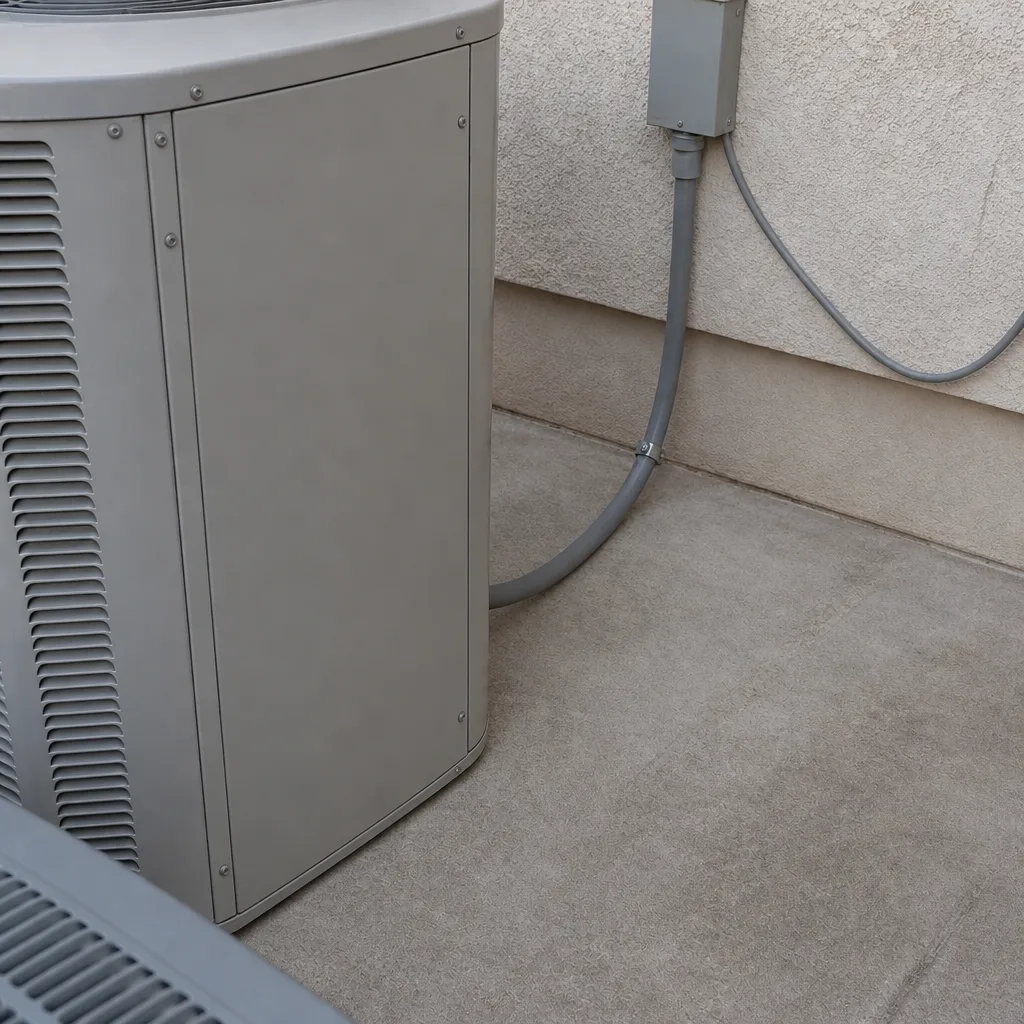
- Check the disconnect box. Most North Las Vegas homes have a gray electrical box on the wall near the outdoor condenser. That’s the service disconnect. It may have a pull-out handle or a switch. Make sure it’s in the on position. Sometimes a previous service visit leaves it off, or a landscaping crew accidentally bumps it.
- Check the float switch. Most installations have a safety switch in the drain pan under the indoor air handler or in the secondary drain line. If the drain is clogged and water has backed up, the float switch opens the control circuit and prevents the system from running. This is a deliberate safeguard. If you can see water in the drain pan, that’s your answer. Clearing the drain is a separate step we cover below.
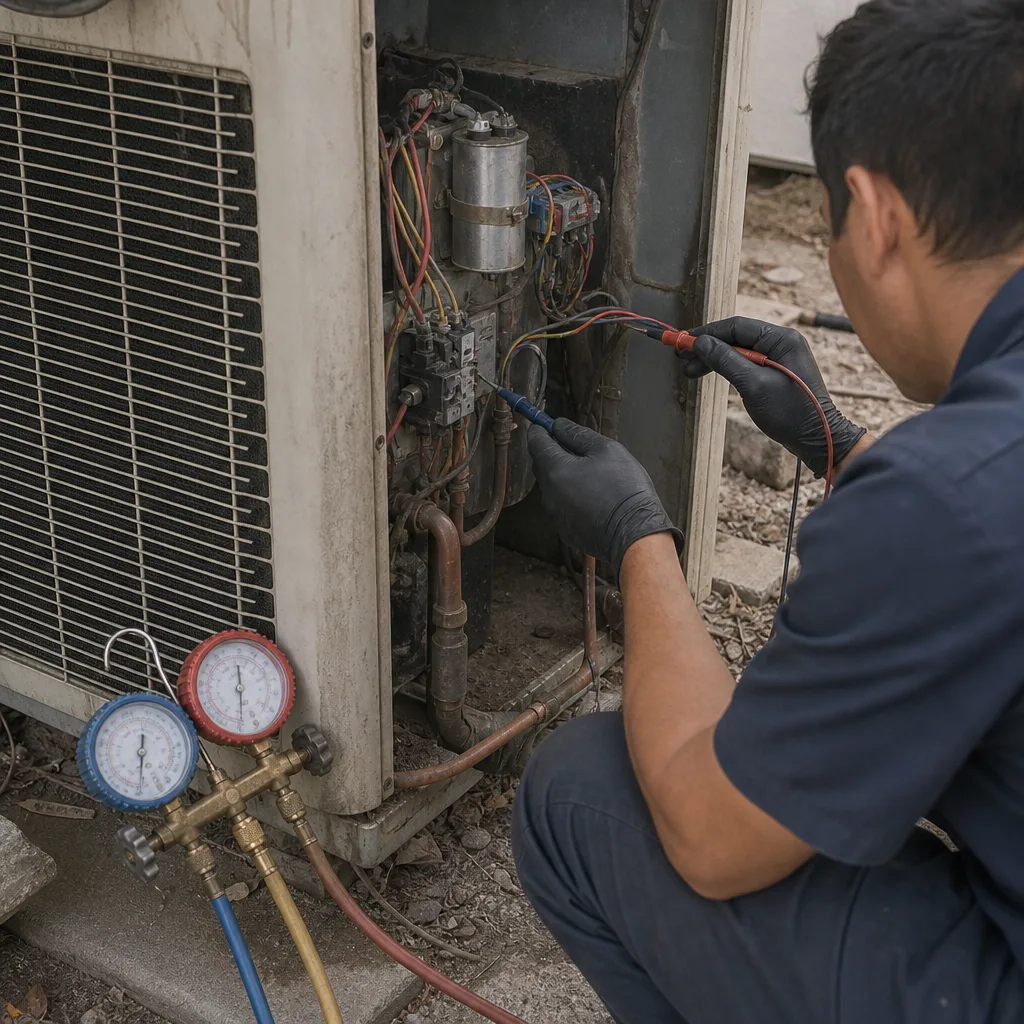
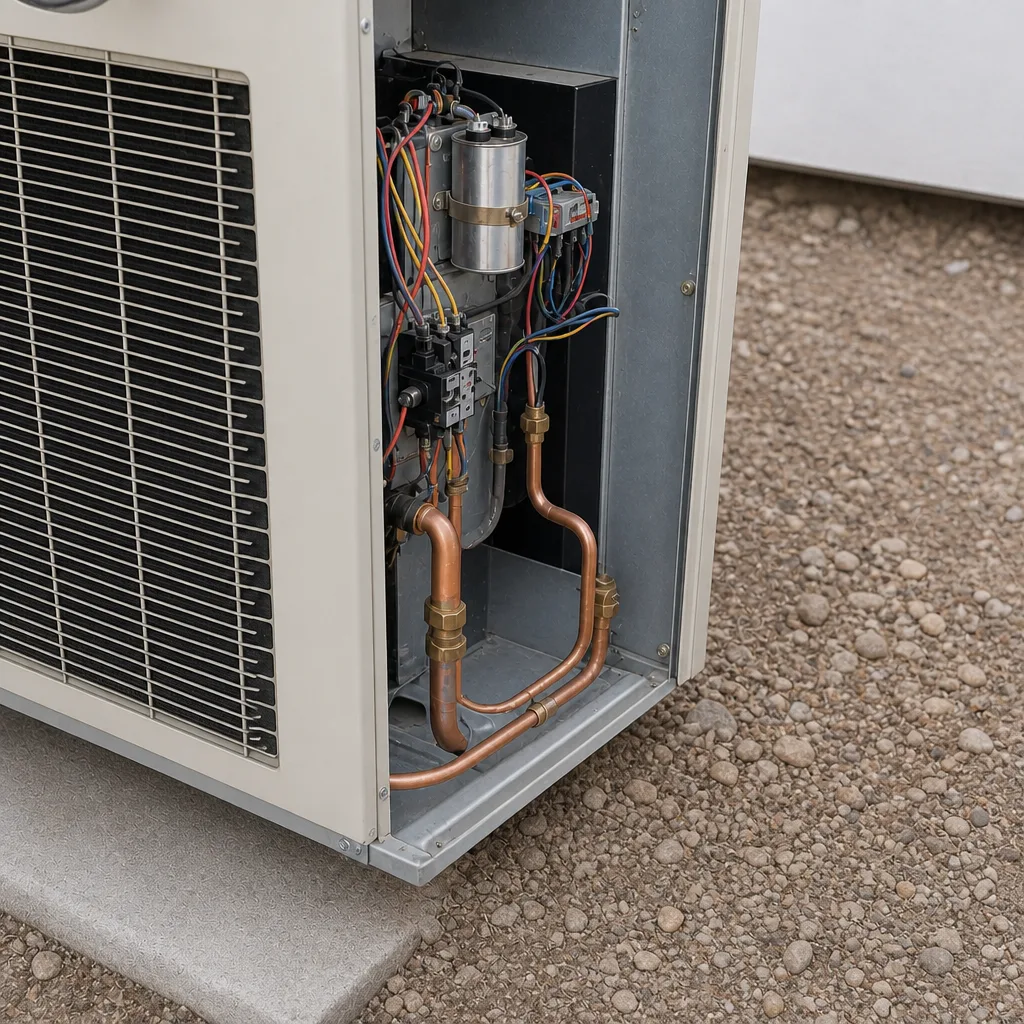
If all of these check out and the unit still won’t start, you’re likely looking at a failed capacitor, a failed contactor, or a control board issue. Those are components that carry 240 volts and are not safe to probe without training. At that point, you want a technician on site. But you’ll arrive at the call knowing the thermostat is functional, the breaker is set, and the disconnect is on, which means the technician can go straight to the unit rather than spending the first twenty minutes doing what you just did.
Dirty Coils and Clogged Drain Lines: The Dust Factor
If there are two problems we find constantly in North Las Vegas that homeowners could have spotted themselves, they’re a dirty condenser coil and a clogged condensate drain line. Both are direct consequences of the valley’s dust, and both are visible if you know what you’re looking at.
The condenser coil
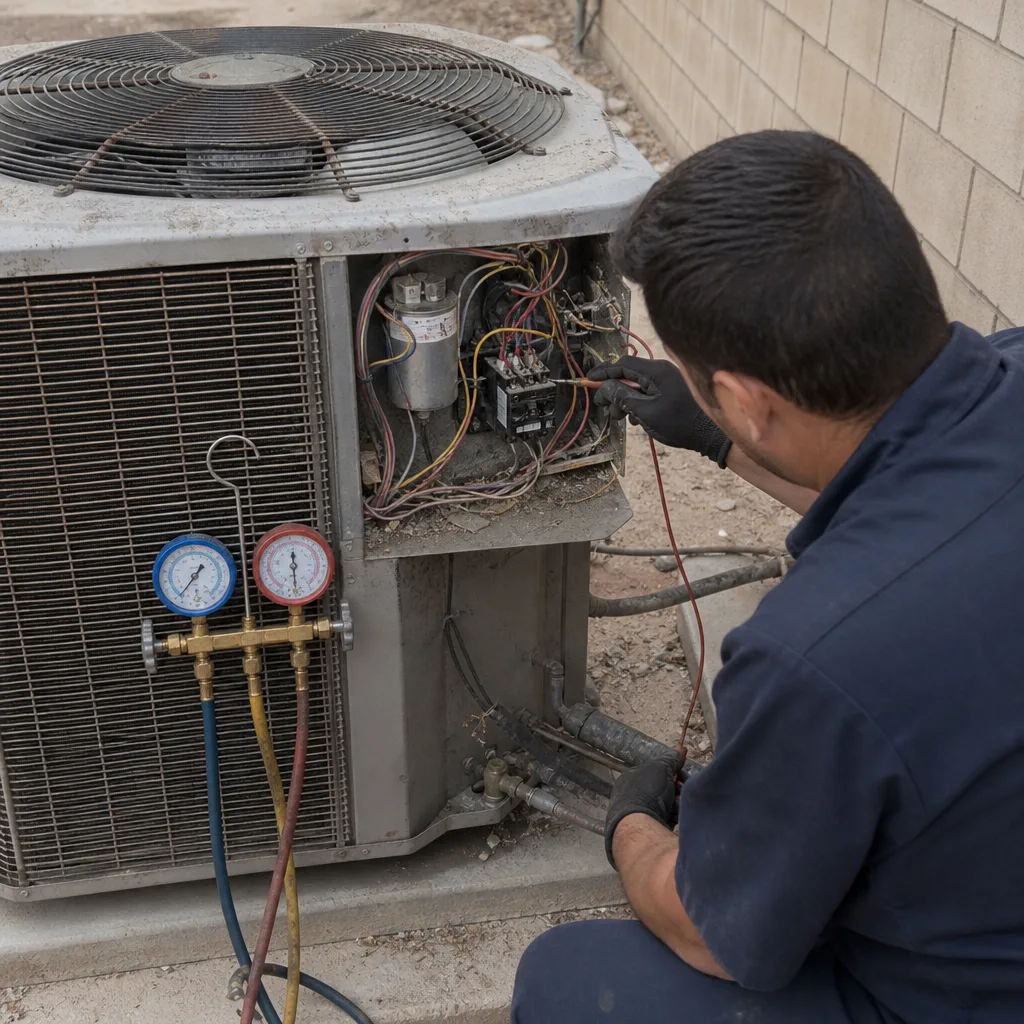
The condenser coil wraps around the outside of the outdoor unit, behind the thin metal fins. Its job is to shed the heat that the refrigerant absorbed inside your house. When those fins are packed with dust, the heat has nowhere to go, so the system runs longer and hotter. You can see this from six feet away. Walk out to the unit and look at the sides. If the fins look gray or brown instead of metallic, if you can see clumps of lint and dust between them, that coil is insulating the unit against its own heat rejection. A coil that looks heavily matted should be professionally cleaned. Spraying it with a garden hose from the outside can push dirt deeper into the fin pack and make the problem worse.
The drain line
Your air conditioner removes moisture from the air as it cools. That moisture drips off the evaporator coil into a drain pan, then flows through a PVC pipe to the outside. In North Las Vegas’s dust-heavy air, that dust gets caught in the wet coil, washes into the pan, and settles in the drain line. Over months, it forms a sludge that eventually blocks the pipe. The water then backs up into the drain pan, and if the float switch is working, the system shuts down. If the float switch fails, the water overflows the pan and damages the air handler cabinet, the platform beneath it, or the ceiling below if the unit is in an attic.
You can spot a clogged drain before it trips the switch. Look at the PVC pipe near the indoor unit. Many installs have a small vertical pipe with a cap on it that acts as a cleanout and vent. If you see standing water at the top of that vent, water in the drain pan, or a wet spot on the ceiling under an attic unit, the drain is clogging. You can often find the outside exit of the drain line on an exterior wall. During a normal cycle, water should drip out of it slowly. If it’s dry while the system is running, the line may be blocked upstream.
What Your Thermostat Is Telling You Before Anyone Opens the Unit
The thermostat is the only part of the system most homeowners interact with, and it carries more diagnostic information than it gets credit for. Before you call anyone, pay attention to what the thermostat is doing, not just what it says. The behavior of the thermostat on the wall can rule out or confirm entire categories of failure.
The display is blank. A blank display almost always points to a power issue at the thermostat itself: dead batteries, a tripped air handler breaker, or a blown low-voltage fuse on the control board. Fix the batteries first. If the display stays blank with fresh batteries, check the breaker for the air handler or furnace. If that’s set and the display is still dead, the problem is in the low-voltage circuit, which means a technician call.
The display is on but the temperature doesn’t match the room. If the thermostat reads 72°F but the room feels like 80°F, the thermostat may be reading the temperature in a cool spot near an open window, or it may be failing. Try moving it to a warmer area temporarily, or set the temperature five degrees below where you think the room actually is. If the system runs and cools, the thermostat’s location or calibration is suspect.
The system starts and stops without reaching the setpoint. This is the short-cycling pattern we covered earlier. Note whether the thermostat display changes when the system cycles. If the displayed temperature jumps up right before the system shuts off, the thermostat may be reading a false rise caused by a failing sensor. If the display holds steady while the system cycles, the problem is likely at the unit itself.
The system won’t turn off. If the compressor runs continuously and the house never reaches the setpoint, that’s a different problem. The system may be undersized for the heat load, the refrigerant charge may be wrong, or the filter may be so restrictive that the system can’t pull heat out of the air fast enough. In North Las Vegas, where a 30°F temperature differential between indoors and outdoors is normal, a system that can’t turn off needs attention before the power bill arrives.
How to Describe Your Problem So the Phone Diagnosis Is Accurate
The way you describe a problem on the phone determines how accurately a technician can prepare before they arrive. Most homeowners lead with a conclusion: “The capacitor is out” or “I think it needs freon.” What the technician actually needs is the sequence of events and the observed behavior. Here’s what to have ready.
- What exactly did you notice first? A warm vent, a strange sound, a burning smell, a puddle near the indoor unit. Write it down if you need to.
- What does the system do now? Runs constantly but doesn’t cool. Starts and stops. Won’t start. Starts but trips the breaker. Each of these points to a different subsystem.
- What did you already check? Air filter, breaker, thermostat batteries, outdoor disconnect, visible ice on the line set. Mention these checks. It tells the dispatcher you’ve done the basics, and it stops the technician from billing you for checks you already performed.
- What brand is the unit? If you know it, great. If you don’t, that’s fine too. We work on equipment from Stratford AC Repair‘s entire serviceable brand list, including Carrier, Trane, Lennox, Goodman, Rheem, York, Daikin, Bryant, and American Standard. Not knowing the brand never blocks a service visit. It does help the technician bring the right common parts.
- How old is the system? If you know the install year from a sticker on the air handler or the condenser, share it. A ten-year-old system with a failed compressor has a different repair-versus-replace conversation than a three-year-old unit with the same failure. Approximate is fine if you don’t know exactly.
- What time of day does it happen? A unit that only fails in the late afternoon when it’s 105°F out is telling a different story than one that fails at midnight. The time pattern helps distinguish heat-related failures from electrical ones.
Doing this before you call the AC repair line means the technician arrives with a mental model already formed, and the on-site time is spent confirming rather than discovering. That keeps the service call shorter and the estimate more precise. It also sends a signal that you’re a homeowner who pays attention, and that changes the quality of the conversation you get.
Common Mistakes to Avoid
- Resetting a tripped breaker more than once. A breaker that trips again after one reset is doing its job. Forcing it repeatedly can damage the breaker and the compressor. One reset is a diagnostic step. Two resets is a hazard.
- Spraying the condenser coil with a pressure washer. The fins on a condenser coil bend easily, and high-pressure water folds them flat, permanently reducing airflow. Professional coil cleaning uses specific chemicals and low-pressure rinsing. A garden hose on a gentle fan setting from the inside out is the only home cleaning method worth trying.
- Running the system with a frozen coil. If you see ice on the indoor coil or the line set, turn the system off. Running it while frozen doesn’t thaw it faster, and it can send liquid refrigerant back to the compressor, which is a quick way to destroy it.
- Replacing the filter and calling it fixed. A dirty filter is often the trigger, but it’s rarely the whole story. If the coil is already dust-caked from months of restricted airflow, the new filter won’t undo that. The restriction just moves downstream.
- Assuming the thermostat is wrong. Thermostats do fail, but they’re wrong less often than homeowners think. A thermostat replaced on a guess without checking the low-voltage wiring or the control board won’t solve the problem and adds a part you didn’t need.
- Ignoring the drain line until the float switch trips. By the time the float switch shuts the system down, water has already backed up. Checking the drain line once a month during the cooling season is a five-minute task that prevents most drain-related shutdowns.
- Hiring whoever is available without asking what brands they service. Some companies in the North Las Vegas market push whatever brand they’re dealer-authorized to install, even if your current system is from a different manufacturer. We take a different approach: we’re certified to service the most common residential brands, and the recommendation follows the problem, not a dealership agreement.
When to Call a Professional
Some problems are safe to observe and safe to describe. Others require the tools and experience of someone who handles HVAC full time. Call a professional if you’ve confirmed the breaker and disconnect are set but the unit still won’t start, if the unit runs but never cools, if you see oil stains near the condenser, if you hear grinding, squealing, or hissing from the compressor, or if the system trips the breaker repeatedly. Those are all signs of failures that are dangerous or expensive to guess at. We service nearly every major residential brand, including York, Daikin, and Bryant, so the diagnosis stays focused on what your system needs rather than what we’re paid to sell. Stratford AC Repair offers free estimates in North Las Vegas. Call (844) 731-3077 to schedule a visit.
Frequently Asked Questions
The most common reason is a condenser coil that’s packed with valley dust and can’t reject heat, followed by a low refrigerant charge or a compressor that isn’t engaging. Check the filter and visually inspect the outdoor coil first. If the larger copper line at the condenser feels warm instead of cold while the system runs, you’re likely looking at a refrigerant or compressor issue that needs a technician.
Check the thermostat settings and batteries, the breaker, the outdoor disconnect, the air filter, and the drain line. Those five checks take about ten minutes and eliminate the most common causes. If everything looks fine and the system still won’t run or cool, call (844) 731-3077 for a free estimate.
During the cooling season, check it monthly. The dust load in North Las Vegas is heavy enough that a filter can clog in four to six weeks, especially if the house has pets or the doors open frequently. A filter that used to last three months in another city may last half that here.
That pattern points to heat-related failure: the compressor’s thermal overload is tripping when the outdoor unit gets hottest. The usual cause is a dirty condenser coil or a weakening capacitor. The coil can’t shed heat, the compressor overheats, and the internal protection shuts it down until it cools. Clean the coil before the heat does permanent damage.
No. We service equipment from the most common residential brands, including Carrier, Trane, Lennox, Goodman, Rheem, York, Daikin, Bryant, and American Standard. If you know the brand, tell the dispatcher so the technician can bring the right common parts. If you don’t, the technician will identify it on arrival.
The cost depends on what’s failed. A capacitor replacement is usually under $300, while a compressor replacement can exceed $2,000. Diagnostic charges are often waived with the repair. Call (844) 731-3077 to describe what your system is doing, and we’ll give you a realistic range before anyone drives out. Estimates are free.
The Bottom Line
Your AC system tells you what’s wrong if you know how to read it. A warm-running unit points to the condenser coil, the filter, or the refrigerant charge. Short-cycling points to overheating or a failing capacitor. A unit that won’t start points to the breaker, the disconnect, or the drain safety switch. None of these are hard to check, and all of them are easier to explain once you’ve checked them. North Las Vegas’s heat and dust make these failures more common here than in most places, but they’re also more predictable. Observe first, check the basics, then call a professional who works on nearly every major brand, including North Las Vegas systems from York and American Standard. For a free estimate, call (844) 731-3077.
Written by the team at Stratford AC Repair, serving North Las Vegas since 2015.
See the difference
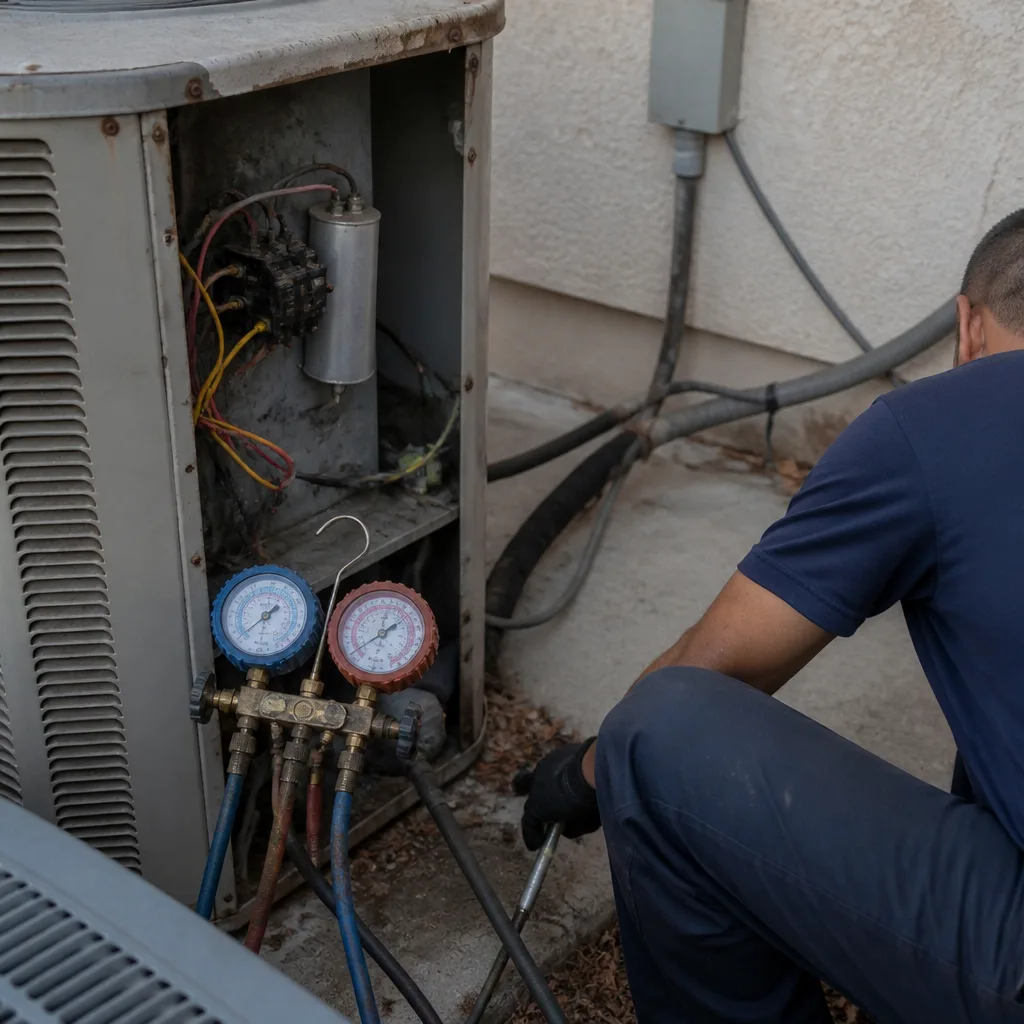 Before
 After
 Before
 After
 Before
 After